
Air pollution has become one of the most pressing environmental challenges of the modern era. From industrial emissions to urban smog and microscopic particulate matter, contaminated air poses serious risks to human health and ecosystems. As the demand for cleaner environments grows, advanced filtration technologies are stepping into the spotlight. One of the most promising innovations is electrospinning for air filtration, a technique that produces ultra-fine nanofibers capable of capturing even the tiniest airborne pollutants.
Companies like Electrospintek are helping push this technology forward by developing high-performance nanofiber solutions designed to improve air purification systems across industries. With its unique ability to create highly porous and efficient filtration materials, electrospinning is rapidly reshaping the future of air quality control.
Understanding Electrospinning Technology
Electrospinning is a fascinating process that uses electrical forces to create extremely thin fibers from polymer solutions or melts. These fibers are typically measured in nanometers, meaning they are far thinner than conventional textile fibers. The result is a web-like structure made up of incredibly delicate strands with a vast surface area.
This intricate architecture is what makes electrospinning for air filtration so effective. The nanofiber layers produced through this method create microscopic pathways that allow air to pass through while trapping harmful particles such as dust, allergens, bacteria, and even certain viruses.
Unlike traditional filtration materials that rely on thicker fibers and dense layers, electrospun membranes combine high permeability with exceptional particle capture efficiency. This balance makes them ideal for advanced air purification systems where both airflow and filtration performance matter.
Why Air Filtration Needs Innovation
Traditional filters, while useful, often struggle to capture ultrafine particles like PM2.5 or nanoparticles generated by industrial processes. These particles are particularly dangerous because they can penetrate deep into the lungs and bloodstream.
Standard filters typically require thicker materials to improve filtration efficiency. Unfortunately, this also increases airflow resistance, which leads to higher energy consumption in ventilation systems. Over time, this inefficiency can raise operational costs and reduce system performance.
This is where electrospinning for air filtration offers a remarkable advantage. The nanofiber networks produced through electrospinning provide superior filtration capabilities without significantly obstructing airflow. In simpler terms, they can catch more pollutants while still allowing air to move freely through the system.
The Science Behind Nanofiber Filtration
Electrospun nanofibers work differently from conventional filtration materials. Their extremely small diameter and interconnected structure create multiple mechanisms for particle capture.
First, there is mechanical interception, where particles collide with the fibers and become trapped within the network. Second, the fibers create electrostatic interactions that attract tiny particles. Finally, the dense yet breathable structure enhances diffusion capture for ultrafine contaminants.
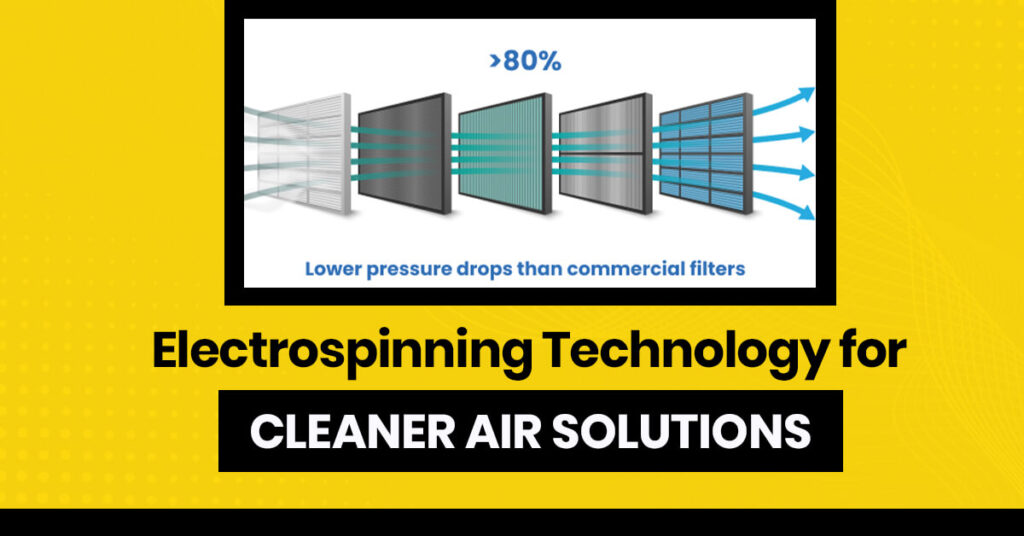
Because of these combined mechanisms, electrospinning for air filtration delivers highly efficient filtration while maintaining lower pressure drops compared to traditional filters. This means systems require less energy to operate, which is both environmentally and economically beneficial.
Applications of Electrospun Air Filters
Electrospun nanofiber filters are finding applications across a wide spectrum of industries. As air quality regulations become stricter and environmental awareness increases, these innovative materials are gaining significant traction.
HVAC Systems
Heating, ventilation, and air conditioning systems are essential for maintaining indoor air quality. By integrating nanofiber membranes produced through electrospinning for air filtration, HVAC filters can capture smaller pollutants while maintaining proper airflow. This leads to healthier indoor environments in homes, offices, and commercial buildings.
Industrial Air Filtration
Manufacturing facilities often release fine particulate matter, fumes, and aerosols into the air. Electrospun filters offer an efficient solution for removing these contaminants before they spread into the surrounding environment.
Industries such as pharmaceuticals, chemical manufacturing, and electronics production benefit greatly from nanofiber filtration technology.
Personal Protective Equipment
Air filtration is also critical for personal safety. Respirators, face masks, and protective gear increasingly use nanofiber layers to improve filtration performance. In these applications, electrospinning for air filtration helps create lightweight yet highly effective protective materials.
Environmental Benefits of Electrospinning
Beyond improving filtration performance, electrospinning also contributes to sustainability. Many electrospun materials can be produced using biodegradable polymers or environmentally friendly solvents. This opens the door to greener filtration products with reduced environmental impact.
Moreover, filters created through electrospinning for air filtration typically require less material than conventional filters while offering better performance. This efficiency reduces waste and extends the lifespan of filtration systems.
Another advantage is energy efficiency. Since electrospun filters allow better airflow with lower resistance, ventilation systems consume less power, which helps reduce carbon emissions.
The Role of Electrospintek in Air Filtration Innovation
As demand for cleaner air grows worldwide, companies specializing in nanofiber technology are becoming increasingly important. Electrospintek is at the forefront of developing advanced electrospinning equipment and materials designed for high-performance filtration applications.
Through innovative research and engineering, Electrospintek provides solutions that enable industries to harness the full potential of electrospinning for air filtration. Their technologies allow manufacturers and researchers to produce consistent nanofiber membranes with precise control over fiber diameter, structure, and performance.
By supporting both research institutions and commercial manufacturers, Electrospintek plays a vital role in advancing next-generation filtration technologies.
The Future of Air Purification
The future of air purification lies in smarter, more efficient filtration systems. With increasing urbanization and industrial activity, the need for innovative solutions will only continue to grow.
Electrospun nanofibers represent a powerful tool in the fight against air pollution. Their unique structural properties make them capable of capturing ultrafine particles while maintaining energy-efficient airflow.
As technology evolves and manufacturing processes become more scalable, electrospinning for air filtration is expected to become a standard feature in air purification systems worldwide.
Conclusion
Clean air is essential for healthy living, yet pollution continues to threaten environments across the globe. Advanced filtration technologies are necessary to combat this challenge, and electrospinning is emerging as a highly effective solution.
With its ability to produce ultrafine nanofibers and highly efficient filtration membranes, electrospinning for air filtration offers a powerful approach to improving air quality. Companies like Electrospintek are driving innovation in this field, helping industries adopt cutting-edge filtration technologies that protect both people and the planet.
As research progresses and adoption increases, electrospinning technology will likely play a central role in building cleaner, healthier air systems for the future.